Showing posts with label eggplants. Show all posts

Friday, 1 August 2014

Potato and Eggplant Moussaka


Although I’ve already posted one moussaka recipe, it occurred to me that since it’s a regional dish it wouldn’t be such a bad idea to add a new recipe for a different version of it. Either way, this is absolutely delicious and filling comfort food that can be eaten at any time of the year, depending on the products that are in season at the moment. And since eggplants are in season right now (and also because I am big fan), I have decided to post a recipe that actively uses them.

So, here’s my recipe for potato and eggplant moussaka.

Ingredients (for 8 portions):

1,5kg potatoes
1kg eggplants
500g minced (lean) meat
1kg fresh or canned tomatoes
1 sweet green pepper
2 onions
3-4 cloves of garlic
150ml sunflower seed or vegetable oil
1 spoon sweet or smoked paprika
½ spoon savory
½  spoon fenugreek (I will post a larger article on fenugreek later on)
Fresh basil leaves
Salt
Black pepper

For the crust:

2 large eggs
400g unflavored Greek yoghurt
3 tablespoons of flour
1/2 teaspoon of baking soda

1.Remove the stem of the eggplants. Cut them into 1cm slices. Salt them generously and set them aside until the bitter juice has been drawn out. For a more detailedexplanation of this process you can go here. Peel the potatoes and cut them into 1cm slices. Cut the onion in half, then cut the halves into thin slices. Remove the seeds of the pepper and cut it into thin slices. Peel and cut the garlic into small pieces.

2.After cleaning the eggplant slices from the juice, place them in a well-oiled baking dish the way it’s shown on the photo. No more than 1/3 of each slice should be overlapped by others. Sprinkle oil on them and bake them in a pre-heated 200C oven until they’re half-done. Remove them carefully from the baking dish so as not to tear them. Repeat the whole process with the rest of the eggplant slices, in case you have any left, then do the same with the potatoes.
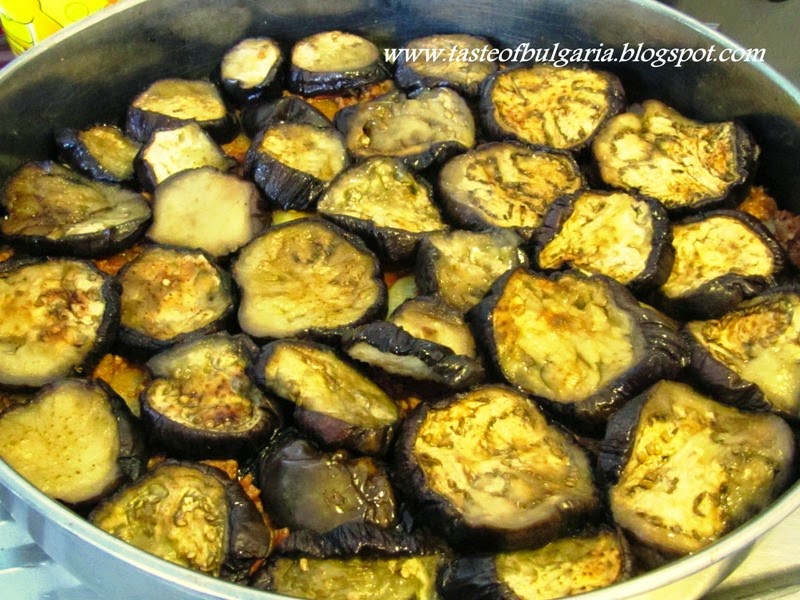
3. While the eggplants and the potatoes are baking in the oven, prepare the sauce. Sautee the onion in 2-3 spoons of oil, then add the pepper, the garlic and the minced meat. Sautee until the meat falls apart. Season with salt and pepper (have in mind the eggplants will be well-salted!). Clear a small space on the bottom of the pot or pan you’re using add the paprika, then let it fry for a few seconds (no more than that, burned paprika tastes bitter), then mix it with the other ingredients and add the fenugreek and the savory. In the end add the tomatoes and about 75-100ml of water and let it boil on the stove, until all the potatoes and eggplants are done baking.

4.Using the same baking dish, pour a thin layer of the sauce, then place a layer of potatoes. Pour another layer of the sauce over the potatoes, then add a layer of eggplants. More sauce, then another layer of potatoes. Bake the dish in a 200C pre-heated oven until the tomatoes on top are caramelized.

5.Mix the eggs, yoghurt and flour. Add the baking soda. Mix well with a spoon. Pour the mixture on the dish and bake until it turns golden. Decorate with the basil leaves.

Wait for the dish to cool a bit before slicing with a very sharp knife and serving. Bon Appétit! 
This recipe was prepared in collaboration with Vkusen Svyat (Tasty World) .

Friday, 25 July 2014

Imam Bayildi - Traditional Eggplant and Tomato Stew


This recipe is a childhood favourite of mine. It’s a traditional Bulgarian dish called Imam Bayildi. It is a vegetable eggplant-based stew. As the name suggests, its origin is Turkish – the truth is that all Balkan cuisines are heavily influenced by the old Ottoman cuisine, due to the region having been part of the Ottoman empire for centuries on end.

There’s a curious story – or a legend, if you will – behind this dish. Well, there are many versions of the story, but this is my favourite one:

Once upon a time an imam (the man leading prayer in the mosque) visited an old and poor Bulgarian woman at her house. The woman, anxious that such an important man was visiting her and worried that she had little for him to dine on, went to her garden and looked around – all she had were eggplants and tomatoes and herbs, so this was what she used to make her stew. Still, the imam loved the dish so much that he stuffed himself full with it and swooned (bayildi) in the end. So the closest translation of the name is “The Imam swooned” (because it was so delicious.)

So, here is the recipe itself. Have in mind that for the best result you will need a large earthen pot.

Ingredients

4-5 average eggplants – around 1,2kg
1,2 kg tomatoes
3 average onions
1 green pepper
1 red pepper
10-12 cloves of garlic
3-4 carrots
2-3 average potatoes
150ml olive oil
2 tea spoons paprika
Salt
Black pepper
A few leaves of basil or parsley

Instructions:

0. Before we talk about the recipe itself, I want to give a short explanation/instruction about the preparation of the eggplants. The eggplants in their raw state are usually full of juice that is quite bitter. Cutting them and using them directly in a dish adds that bitterness to it, so beforehand we need to get rid of it – and we do so by using salt. Cut the eggplants, place them in a bowl, then salt them very well. Mix them with your hands then set them aside for at least half an hour. I strongly recommend doing this step before you start preparing all the other vegetables. After a while you’ll notice that the salt has drawn black, bitter juice out of the pieces, which is gathering at the bottom of the bowl. When you are ready to use the eggplants gently squeeze the pieces then wash off the salt. Have in mind that the flesh of the vegetable has already become quite salty and you need to take this into consideration when seasoning the dish!

1. Remove the stems of the eggplants and cut them into large cubes, then leave them in a large bowl and salt them well to draw out their bitter juice. Place the tomatoes in boiling water for a few seconds, then peel them and cut them into pieces. Peel and cut the potatoes. Peel and cut the onion into small pieces. Peel and slice the carrots. Remove the seeds of the peppers and cut them into pieces. Peel the garlic cloves. If they’re large, cut them in half.

2. Sautee the onion, peppers and carrots in a small pot with a 100ml of the olive oil. Add the paprika and wait for about 30 seconds before adding the tomatoes. Let everything them boil a bit on low heat until they are half done. Towards the end add the potatoes so they boil only for 2-3 minutes. Place the mixture in the earthen pot. Place the rest of the tomatoes, olive oil and the well-squeezed pieces of eggplant in the metal pot and boil them on low heat until the latter soften. Stir gently with a spoon (I recommend using a wooden one) so as not to damage the pieces of eggplant.

3. Pour the rest of the tomatoes and the eggplants in the earthen pot. If you find the mixture to be too thick, add around 150ml of water. Add the garlic, season with salt and pepper (have in mind that the eggplants themselves have already been very well-salted!) mix well with a spoon, place the lid on and put the pot in a cold oven. Turn it up to 190C and let it bake for about 40mins.

4. Cut the basil or parsley in small pieces and sprinkle it on the dish before serving. You can also add a piece of feta cheese. The Imam Bayildi can be served either hot or cool.

The truth is, you can prepare the whole dish on the stove without using an oven or an earthen pot by simply letting all the vegetables boil together until they are done. However, using a stove and an earthen pot considerably improves the taste and texture of the ingredients – all the vegetables remain whole while gaining a lovely silken texture and aren’t mushy at all. The dish itself looks gorgeous in the pot and on special occasions can be served whole on the table.


This recipe is a collaboration between Vkusen Svyat and myself.